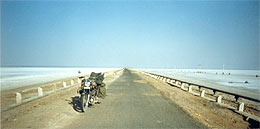
 There are actually two routes to Dholavira. I preferred the long one because my objective was to cover the GRK to the extent possible. One incidence I must tell you. I was reaching Fatehgadh. The road bifurcated. I wanted the road to the Rann stretch. But then the condition was that I should not end up routing back to this bifurcation for catching the road to Dholavira. I decided to ask a local. After waiting for around 10 minutes, heard the sound of a mobike’s engine. When the biker arrived, I waved to get his attention. He stopped. He was in his thirties. I told him my query. He said road is butchered by the tractors and is not negotiable. Then he suddenly said,”Achha mere peeche aao”. Ok, follow me. Good luck for two reasons. A hindi-speaking fellow and a benefactor :-)
I started trailing him. He entered into the town. Everybody was staring at me like hell. It was like Fatehgadh had come to a standstill to watch the passing phenomenon. Few people greeted my leader. Clue – the person was local of Fatehgadh. Then suddenly he took a turn into a narrow lane. I got curious but more of a scary feeling that was, to confess. He got into the Rann. It was all silty and riding on the silt was extremely difficult though his 100 cc was much smoother. Weight factor, perhaps. After riding for around two kilometers and with more and more wilder the landscape becoming I really got scared. Where the hell am I being taken? No I was not taken for a ride. The fellow actually left me on a road only a few moments later. He guided me for my way further and also informed me about the road conditions and where I will get best views of the Rann. He burnt his fuel for what? Just to make me avoid that non-negotiable stretch of road. What must have been his interest? Nothing, I guess. Can you get a gesture like this in Metros? Over and above, read this. After reaching on the road I stopped for taking the pic of the point where the gentleman left me to keep as a remembrance. While returning back he spotted me standing. He shouted from there. He was hardly audible. Then he used his horn. You can guess the distance. I turned around to see him standing and waving questioningly. I showed him the camera for saying “No problem” and bowed in obligation. Isn’t it amazing? I proceeded further on a straight road. Few kilometers beyond, I was treated with some of most spectacular views of the Rann landscapes. Small hillocks and a large expanse of Rann. Not only riding but even simple walking on the terra was difficult. The climate throughout is of semi-arid to arid type and the region has a very erratic rainfall pattern. The vegetation is minimal and 98% of the plants, bushes and trees belong to the genus Acacia spp. (had been a botany student :-)) Salinity, erratic rainfall and a perennial shortage of fodder, makes life pretty difficult here. Nature’s denial of greenery has been prominently substituted by the colorful costumes of the Kutchi Folks. An interesting fact is that each caste is distinguished by the designs, patterns and the colors of the embroidery on their clothes.
I kept on proceeding towards Dholavira, asking the locals, trying to understand their answers and guessing broadly from East West – North South. I had to keep straight towards west but roads are not that straight and by this time I already gave up riding on the silt of Rann. Intermittently, I kept checking the BSF posts on my right to get the feedback and enjoy their point of view. The whole way is dotted by numerous small villages in spite of severe water scarcity, especially in summers.
Whosoever overtook me or vice-versa, was looking overawed. It seemed like they don’t get to see many bulleteers thumping there. Then came a big village, Amarpar. Here one state transport bus was having a break along with its passengers. Almost every passenger was scampering for water. There were two big pots filled with water. I thought tanking-up water is not a bad idea. So I also stopped. All I can say about the water is that it was black/gray. And yeah, you guessed it right – I drank it too.
Throughout the way, I found signboards from this or that charity, building houses under the Quake Relief Fund. I reached Dholavira at around 4:00 pm. The place is known as Kotada locally. The road to the archeological site was under construction in full swing, so was the spick and span resort. Even Archeological Survey of India (ASI) has constructed a beautiful complex at the place.
I parked the bike at the gate of ASI camp. When I expressed the desire to see the site to the watchman, he took me to the supervisor. This gentleman, showed me around the complete site and explained to me every detail in a very nice manner. For the kind information, here is a small account of what I experienced there.
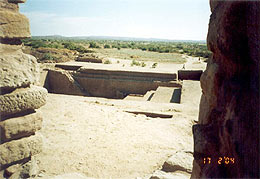 Dholavira site is a Harappan contemporary (3000 B.C.) and was discovered by Mr. Jagatpati Joshi in 1967-68. ASI started excavations in 1990 under the directions of Dr. R. S. Bisht. The site is located on an island called ‘Khadir’ and spread in an area of about 100 Hectares in the salty marshes of the GRK. This erstwhile fortified, three-tiered city was an architectural beauty and an example of our rich knowledge of water harvesting structures. Two storm water channels, Manhar (north) and Mansar (south) flanked the city. The city had provision for rainwater and floodwater harvesting. Not even that, even filtering mechanism was also there by creating a series of reservoir. I was fed with so much of knowledge that I can write a 600-word essay on the excavation of Dholavira. Notably, world’s oldest signboard has been discovered here and so far is undeciphered.
ASI officer-in-charge, Dr. K. C. Nauriyal, is a gem of a person. He informed me that his team works here from September to April because it is difficult to work in the very harsh summer period. We chatted for around an hour and he gave me lots of knowledge about the excavations, Dholavira, and his experiences. He was very appreciative of me bitten by travel bug.
Imagine me in a Kutchi hut. It was one of the best nights of my life. Next day morning I discovered that Dr. Nauriyal’s hut is actually a mini-laboratory. It was equipped with all modern IT paraphernalia. I asked permission for a few photographs of the site to which he promptly agreed. Stay in the ASI camp, talk with a Delhi fellow in the middle of GRK and kutchi delicious food. Indelibly imprinted on my memory.
I Couldn’t Ask for More. On my way back, just after riding a kilometer, I saw “Rann – 3Kms” on a BSF signboard. One BSF post was there. But the signboard pointed in a different direction. So instead of Bhuj, I started riding in the direction of the Rann. After all, that is what I had come all the way for seeing. This route was on my itinerary when I first made the plan. But later I came to know that the road is incomplete. So I planned this day of my ride for Bhuj and further. But with my fascination for the Rann at peak, I couldn’t resist the idea of going upto the point the road was made and then come back all the way.

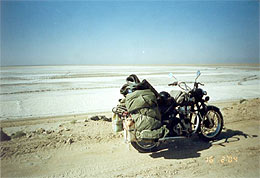 I reached the first post of BSF at around 6 pm. The men there were very friendly and were awed by the fact that I came on a mobike all the way from Delhi. They showed me the way to Nadeshwari. While starting from there for Nadeshwari temple, I asked them if I have to submit my camera and mobile. They promptly persuaded (and not forced) me to submit the same because of the security reasons. They also informed me that both the things would be captured if I take them beyond this point. Nadeshwari is basically a shrine of a Goddess. The way to reach the place makes you ride in the middle of nowhere in GRK. Jeep tyres made the dirt tracks that I followed. The BSF men instructed me to keep to my right or I’ll end-up in the custody at the Border. I followed the ‘rightest’ track I could see, as I had no intention to cross the border. The tracks were full of mud and it was very difficult to ride on them. The scenery was breathtaking. The sun was about to set and for miles I could only see the brownish-red muddy plain landscape. The red color of sunrays and very light brown of mud gave a peculiar mix. It is actually a vast, featureless, endless salty terrain. I missed my camera, dearly that day. I reached the second post of BSF at 7.20 pm. It was pitch dark. I parked the bike before their tent and introduced myself. The men enquired about various things and I answered them to my sincerest extent. Then they asked to check the luggage to which I readily agreed. I showed them each part of my luggage. They took away the knife that I brought for cutting the lemons. BTW, it is always good to carry lemons, sugar and salt of which I carried only the former two, as I knew salt will never be a problem in Kutch :-). They told me to ride straight and after a while I was supposed to see some bulbs. I had absolutely no idea where I was heading for. Riding was difficult. All the lights that I have on my bike were on. After riding for about 400 meters I saw some lights. I parked the bike before the gate and went inside to ask whether I can stay. Seeing a stranger, a lot of people congregated as if I was being exhibited there. Language was a big problem. Nobody understood what I meant. Then one servant who had served in Rajasthan came out of kitchen. He could get my words and did an unpaid translation for me. I was showed the way to the third BSF post. “How many posts does BSF requires to check my identity”, I wondered. It is a rule in the temple to register every staying person with BSF. The post is only few meters away from the temple complex. The BSF men appreciated the spirit and asked me to take rest at the temple.


 Thereafter, we spent nearly two hours of early morning at the pond of Kidana, and shot photographs and videos as well. As it was early hours (about 9 am onwards) the birds were settling at their positions to take morning sunbath. Ordinarily after a chilled night, birds warm up themselves before getting involved in other activities.
 After Kidana, we left for the lake at Shinay village. We had expected little or no activities at the lake as it was noon time, however we spotted a large flock of White Pelicans getting ready for taking off.
 To cover Kutch of different period , PCoG decided to pay a visit to Kutch Fossils Park situated near village Gondiyar, Tal. Nakhtrana, Kutdch on 08-03-2009.
 In the absence of sufficient resources , he maintains all those fossils in a small room openly on wooden ramps. At PCoG we have decided to cover his work photographically , and publish through the medium net. Further his knowledge regarding the geography and history of Kutch is very vast and is useful we wish to record it somehow.
 Thereafter we visited anicent temple of Than Jaagir. The temple is of Dharamnath of Nath Sampradya. Near to that temple, one abandoned temple is there, which is to be said as the old buddhist monastery. Howerver there was nothing to prove the legend.